

Think: use ONLY sound to move minuscule machines! This is the promise of acoustic actuation, a jiggly way to commandeer robots from afar. Sound waves push cells, bubbles, and particles around in liquids, making it possible to wirelessly power microrobots. But what about in air?
Just like blowing across the top of a bottle, where air vibrates and hums in a resonance called Helmholtz resonance. Inspired by this relatively simple hack, researchers at EPFL constructed vesicular systems that behave like tiny sound‑driven engines.
Instead of just nudging objects with sound, they designed resonators tuned to specific frequencies, turning vibrations into thrust and controlled motion.
As lab head Selman Sakar explains, “it’s about transforming a simple piece of material into ‘robotic matter.”

Rather than floating objects with sound alone, the team at EPFL created devices that convert sound into propulsion. The key is hollow, spheroid or bell‑shaped cavities. Sound waves energize the air within them, vibrating the air in vectors that force out a jet of concentrated air to generate thrust. The cavities can be made from common materials, including 3D‑printing plastics or rubbery polymers and even glass.
World’s most powerful acoustic tractor beam could pave the way for levitating humans
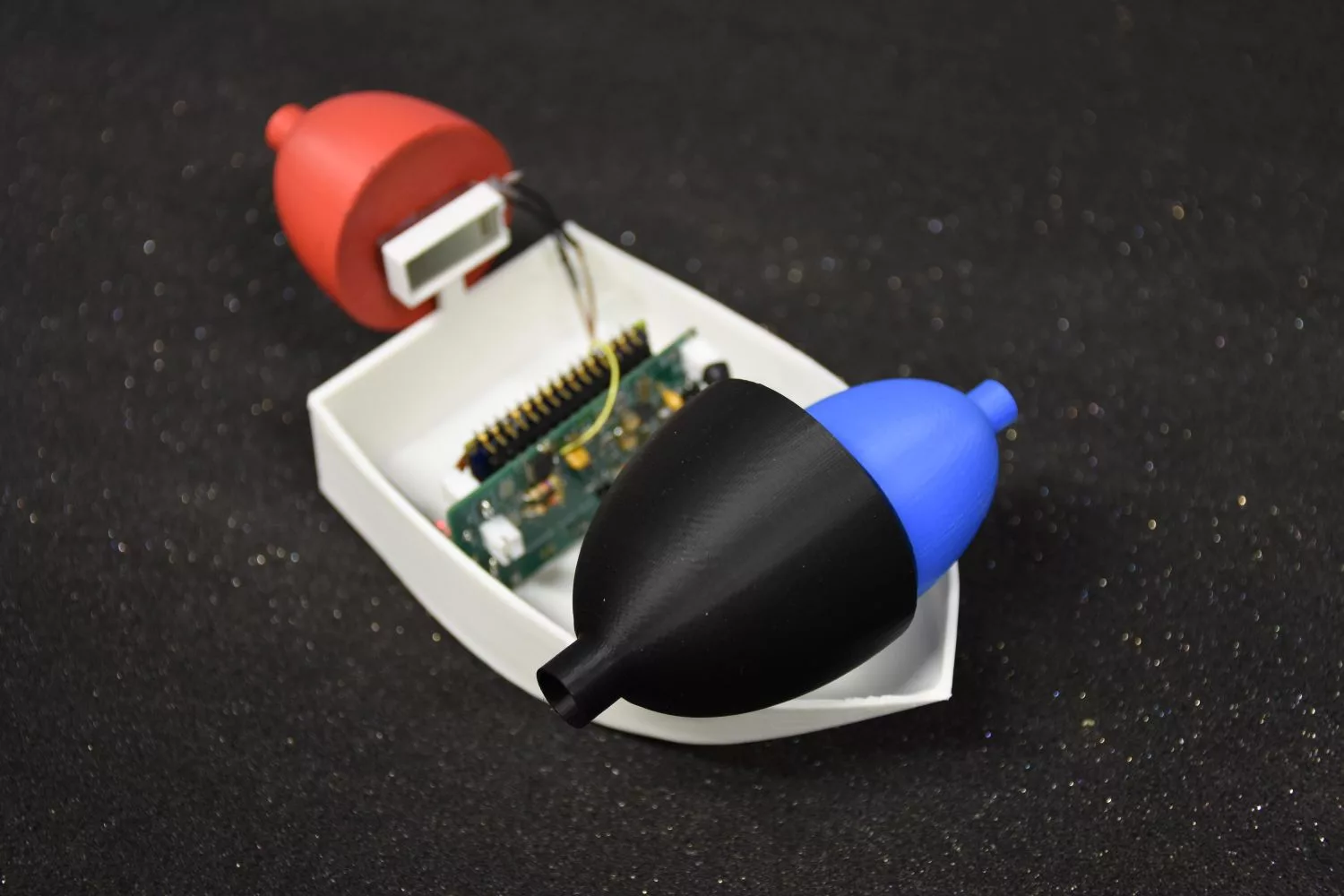
At the centimeter scale, the researchers built tiny boats with up to three cavities, each tuned to a different audible frequency. By changing the sound from a speaker, they could steer the boats, move them around obstacles, and even program them for autonomous navigation.
Microscopically, they produced “microfliers”, ultralight flying vehicles that can be activated using ultrasonic waves with the help of 3D nanoprinting. Another design, weighing only 150 micrograms, shot straight up like a rocket. Yet another multiplex cavity that spun (at 13,000 rpm no less) to hover a vehicle like one of those helicopter drones.
Unlike devices that rely on motors or gears, these technologies work with hollow cavities for larger nominal volume replacement rather than bulky moving parts and magnets to create a motor; therefore can be made very small and light using modern 3D-printing techniques designed such an application.
“Our concept is compatible with even further miniaturization, enabling advanced designs that push the boundaries of robotics and aeronautics,” explains PhD student Junsun Hwang. Looking ahead, lab head Selman Sakar envisions flexible devices built with multiple sound‑responsive cavities, each tuned to a different frequency.
With such designs, certain sections might bend and flex in response to sound-induced vibrational forces or change shape in a way that makes it possible for aero-supported robots to modify their form while flying.
Journal Reference:
- Junsun Hwang, Quentin Angeloz, Ashwin Subramanian Murugan et al. Acoustic resonators as wireless actuators in air for small-scale robots. Science Advances. DOI: 10.1126/sciadv.aef5620