

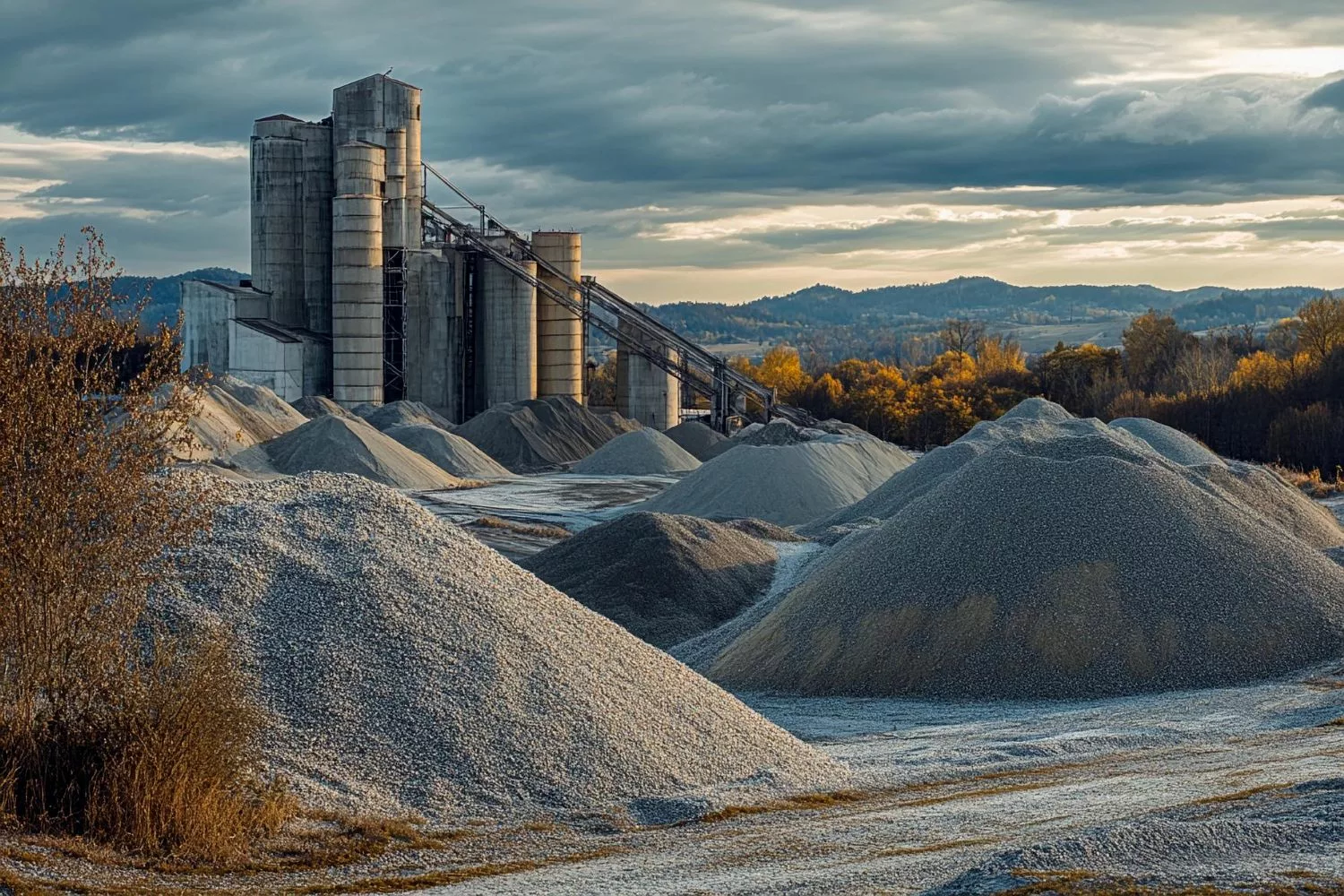
Cement is everywhere, in our homes, bridges, schools and even skyscrapers. Every year the world churns out about 4 billion tonnes of it. But when it comes to climate, very few things stack up like cement: calcination, the heating of limestone, releases huge amounts of carbon dioxide (CO₂). Today, 5–8% of global CO₂ emissions result from cement production.
A study at ETH Zurich, jointly with Heirloom Carbon Technologies, provides a potential means of converting this climate concern into part of the remedy. By integrating cement production with Direct Air Capture (DAC) technology, in which CO₂ is captured directly from the atmosphere and stored so it does not enter circulation again if burned, it could mean ensuring that cement becomes a carbon sink rather than merely an emissions source.
But DACCS technologies have a huge, and maybe the most important, challenge: How can we deploy them sustainably, at gigatonne scale, without running out of resources or creating new environmental burdens? The study offers a compelling answer through calcium-looping DACCS, a process that could integrate seamlessly with one of the world’s most carbon-intensive industries: cement.
It all comes down to calcium looping, a chemical cycle that some cement plants are familiar with. Here’s the process:
Limestone (CaCO₃) is heated in a kiln until it decomposes into quicklime (calcium oxide, CaO), releasing CO₂. This process is also called Calcination. In a DAC-integrated cement plant, the kiln is powered by electricity instead of fossil fuels, avoiding combustion emissions.
The CO₂ released during Calcination is captured directly, uncontaminated by exhaust gases. Quicklime reacts with water to generate slaked lime [(Ca(OH)₂)] that can absorb additional airborne CO₂ and change back again into limestone. The CO₂ is compressed and stored underground, whereas the limestone can be mixed back into the production of cement.
This cycle means the same calcium compounds can both make cement and capture CO₂ from the air.
Electricity could make cement without massive pollution
According to lead author Vittoria Bolongaro, the approach could reduce cement’s climate impact by 78% by 2050. “From a climate perspective, the combination of DAC and cement production is very promising,” Bolongaro said.
The study found that DAC plants using calcium looping can achieve a net-negative carbon footprint. Depending on the energy mix, efficiency ranged between 85–96%. In other words, for every tonne of CO₂ captured and stored, only 40–150 kg of CO₂ are generated in the process chain.
The biggest factor is energy. DAC is energy-intensive, and the climate benefits depend on powering kilns and capture systems with low-carbon electricity. Using today’s U.S. electricity mix, efficiency is lower. With wind, solar, or autonomous photovoltaic systems, efficiency climbs dramatically.
Heirloom Carbon Technologies already operates a commercial DAC plant in California with a capacity of 1,000 tonnes of CO₂ per year, and a larger facility is planned in Louisiana. Partnering with ETH researchers allowed both sides to test the environmental footprint of DAC cement integration using real industrial data.
“Heirloom was an ideal partner for us because the company is already operating the first calcium looping DAC systems on a commercial scale,” Bolongaro noted.
The study is the first prospective life-cycle analysis of calcium-looping DAC at industrial scale. While the results are promising, challenges remain, especially in economic feasibility, where large-scale electric kilns are not yet widely deployed; Infrastructure limits, in which more detailed studies are needed to assess physical and economic boundaries; and policy support, in which scaling DAC-cement integration will require incentives and global cooperation.
That said, the vision is also well-understood: cement plants could go from one of the world’s biggest carbon-polluting industries as carbon emitters to potential future climate solutions as carbon removers.
Journal Reference:
- Bolongaro V, Shu DY, McQueen N, Bardow A: Life cycle assessment of solid calcium-looping direct air capture and its synergistic dual use for net-negative cement. Chem Circularity, 4 June 2026, DOI: 10.1016/j.checir.2026.100041