

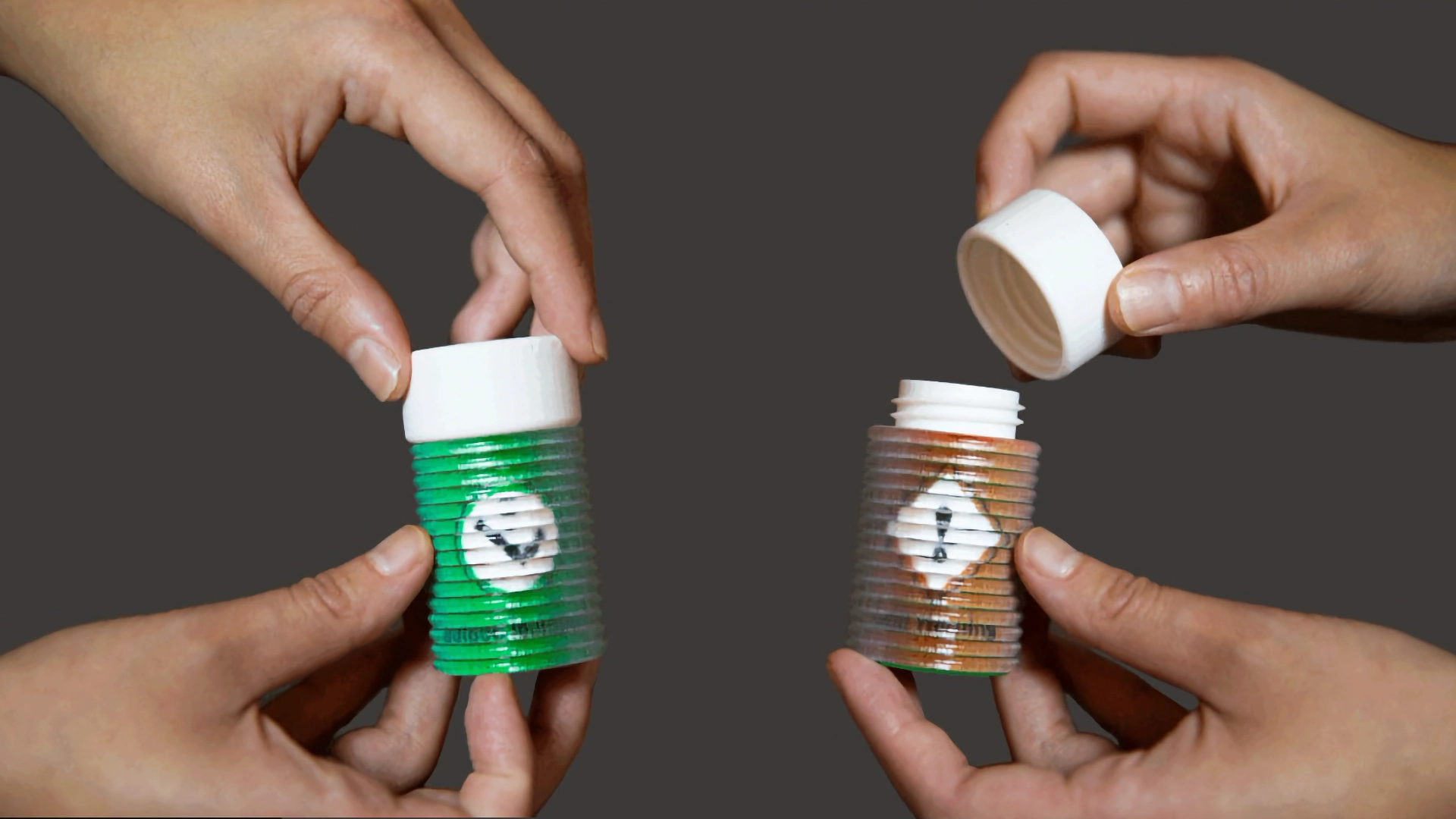
Imagine everyday objects that can talk back to you, not with electronics or screens, but simply by changing how they look when you use them. That’s exactly what MIT researchers have achieved with their new ShiftLens 3D-printing system.
Instead of relying on fragile circuits or displays, ShiftLens uses layers of tiny lenses and patterned surfaces built right into the object. When you twist, press, or slide a part of the object, the layers shift against each other, revealing a new image or pattern.
Think of it like those lenticular postcards that change when you tilt them, but here, the effect is interactive and tied to how you use the object.
Many interactive products rely on fragile electronics to change their appearance, which water, chemicals, or pressure can damage. Traditional optical methods, like stickers or lenses, create static effects with limited interactivity.
3D-printed platform that works using living matter
To overcome this, MIT researchers developed ShiftLens, a system that converts user designs into 3D-printable models with surfaces that can mechanically switch appearances, without electronics.
The design uses two optical layers: a patterned backplane and a layer of tiny lenticular lenses. Shifting the lens layer reveals different parts of the backplane, changing the object’s look. The biggest challenge, researchers note, was aligning the optics, mechanics, and graphics to work seamlessly together.
To make the design process easier, the researchers built a user-friendly tool that automatically generates a ShiftLens structure from a few inputs, like the images a user wants to display and the object’s shape.
Because ShiftLens requires a shifting motion, it doesn’t work for every object, but users can build it into designs with natural movement (like twisting a lipstick tube) or add mechanisms like knobs or switches.
Painting complex 3D-printed objects entirely new way
The team demonstrated its potential with objects such as a chemical bottle that changes color and symbols when the cap is tightened, and a tic-tac-toe game with squares that shift between X, O, or blank.
While aimed at makers, the technique could scale to industrial uses, like pipes that change appearance to show leaks. The researchers plan to expand the tool with smarter algorithms and more actuation options for future applications.
Yunyi Zhu, a graduate student in the MIT Department of Electrical Engineering and Computer Science (EECS) said, “The leaking sink in my apartment would be a lot easier to fix if it could tell me where the leak was coming from.”