


Smartwatches, phones, and drones all depend on lightweight, rechargeable power systems. But when those devices wear out, their batteries often end up as electronic waste. A team of researchers reporting in ACS Energy Letters has now designed a compact zinc-ion supercapacitor that can be taken apart quickly and reused, without sacrificing performance.
The device is built from a zinc metal–copper foil anode, an activated carbon-fiber cathode, and a solid electrolyte made from a porous resin soaked in zinc chloride solution.
The resin bonds tightly when heated but dissolves in a mild acidic liquid, allowing the layers to separate within 30 minutes. That means the carbon-fiber cathode can be recovered and reused in new cells. Finally, they fused the layers with heat, forming a thin device with a 2-volt potential.
As proof of concept, the team integrated four of these supercapacitors into the wings of a model glider. Powered by the devices, the glider’s propeller carried it 12 feet (3.7 meters), a clear improvement over the 8 feet (3.4 meters) it managed without external power.
New Zinc-Ion battery to store grid energy
The researchers placed one of the supercapacitors in a mildly acidic, water-based solution to take it apart, and within 30 minutes the layers separated. The recovered carbon-fiber cathode was then reused twice more, each time paired with fresh solid electrolytes and zinc anodes, showing how the device could be efficiently recycled.
The recyclability is just as impressive as the flight test. The recycled carbon fibers were reused two further times, each with new electrolytes and fresh zinc anodes. The fibers survived over 172,000 charge–discharge cycles and continued to function across fabrication and recycling.
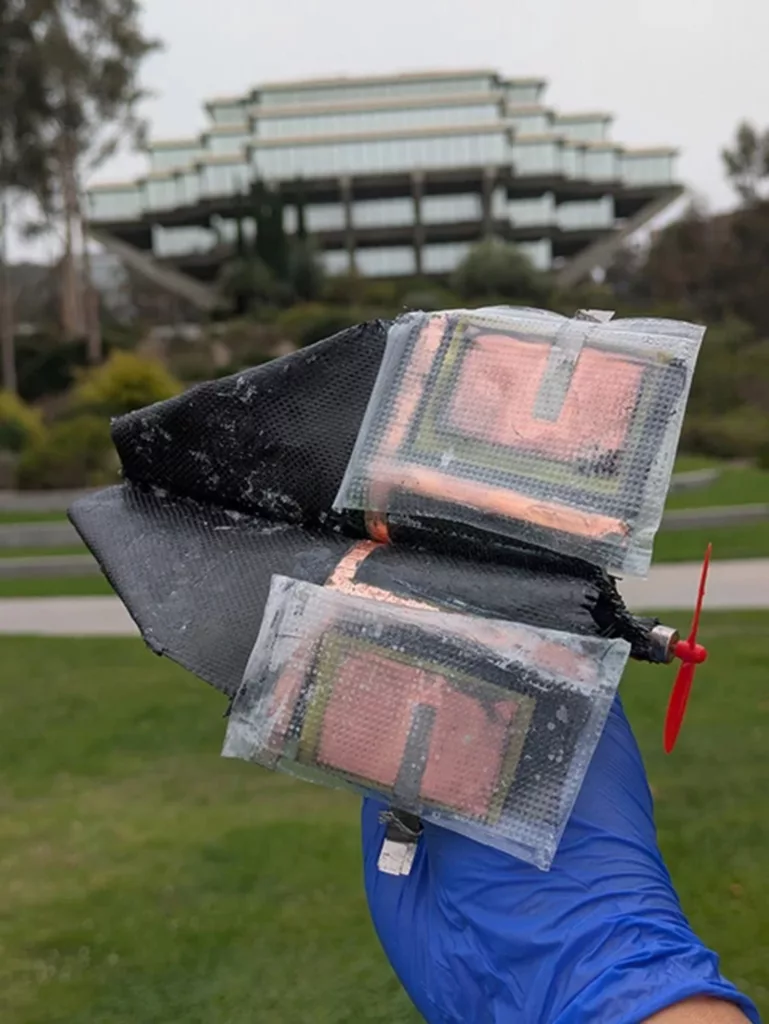
This glider’s propeller was powered by prototype supercapacitors on its wings that can be disassembled and recycled into new energy storage devices.
Tse Nga Ng
Lead author Nandu Koripally emphasized the broader vision: “Sustainability and performance do not have to be competing goals.”
By designing energy storage with its full life cycle in mind, the team shows how devices can be both powerful and easy to repair, reuse, and recycle.
Journal Reference:
- Nandu Koripally; Lulu Yao; Robert Chambers; Shengqiang Cai; Tse Nga Ng. Recyclable Zinc Ion Structural Supercapacitor Enabled by Porous Vitrimer. ACS Energy Letters. DOI: 10.1021/acsenergylett.6c01274