

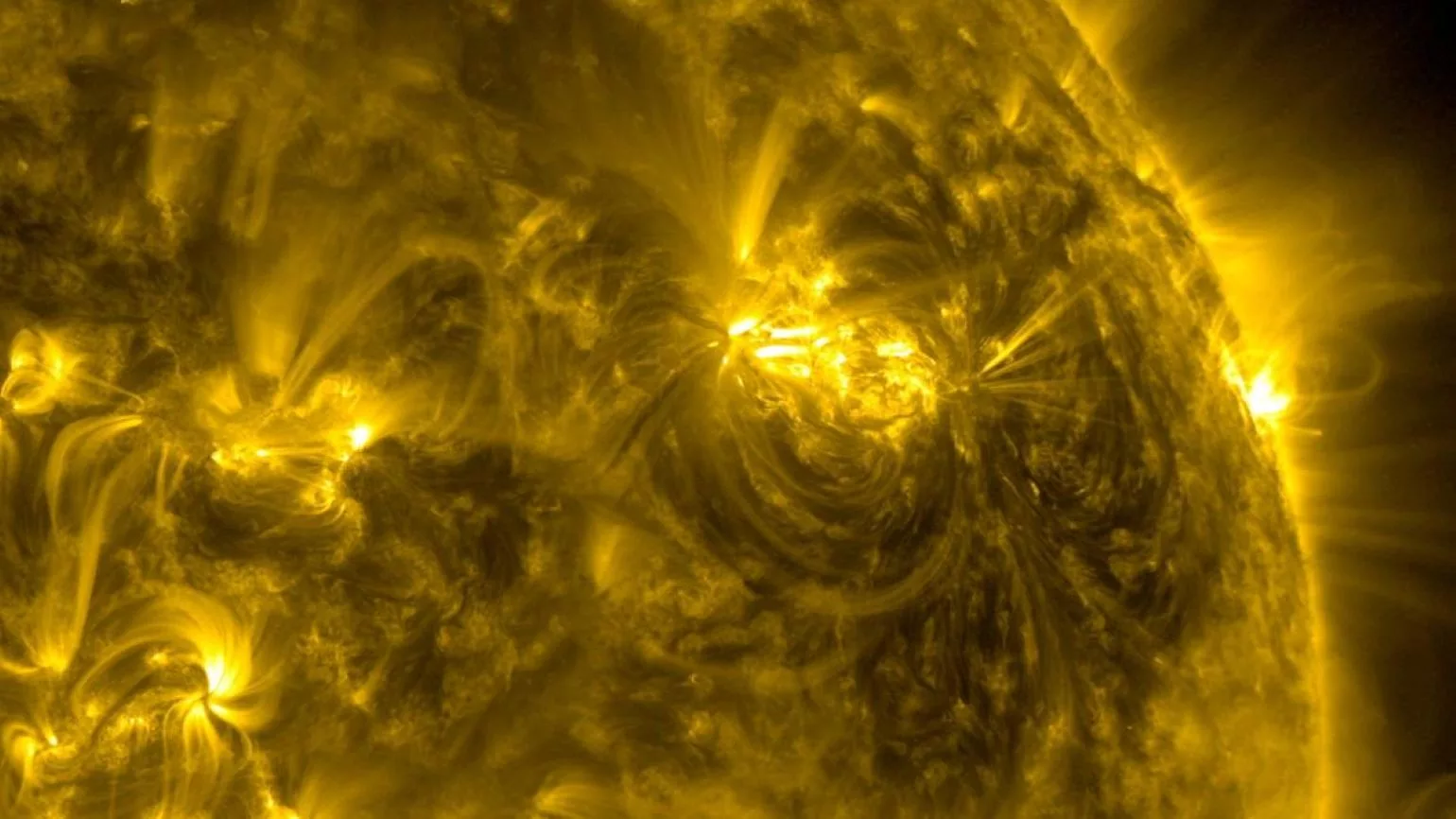
Long before dark sunspots appear on the Sun’s surface, subtle signals ripple beneath. Once these latent percolations are complete, it signals the emergence of active regions, highly magnetically concentrated locales from which solar flares and eruptions can occur.
Now, researchers say artificial intelligence can detect those faint signs nearly nine hours in advance, offering a potential early warning system for space weather.
In a study published in the Journal of Geophysical Research: Machine Learning and Computation, a team led by the New Jersey Institute of Technology (NJIT) unveiled EarlyDetect, an AI model trained to recognize precursor signals in the Sun’s acoustic vibrations and magnetic field.
Using data from NASA’s Solar Dynamics Observatory (SDO), the model identified the emergence of active regions before they became visible.
Researchers to develop AI-powered solar eruption forecasting system
“The most valuable thing this work shows is that we can use machine learning to predict when solar active regions will emerge in advance,” said Jonas Tirona, NJIT undergraduate researcher and lead author. “That early warning could allow satellite communications companies or power grid companies to prepare and potentially mitigate damage from solar storms.”
When this active region protrudes from the surface of our Sun, it bends acoustic waves. It creates sound-like oscillations that astronomers analyze via a technique known as helioseismology.
EarlyDetect uses a Transformer architecture, the same AI technology behind large language models, to learn patterns in solar data instead of text.
Surprisingly, the team found that filtering techniques meant to highlight short-term patterns actually erased the faint fluctuations most useful for prediction.
Alexander Kosovichev, distinguished professor of physics at NJIT, stated, “That surprised us most. We initially expected it to help isolate useful short-timescale patterns. Instead, it averaged away the very faint fluctuations that provided the earliest warning.”
Removing the filters improved the model’s accuracy, allowing it to forecast active region emergence an average of 9.24 hours ahead, outperforming previous methods.
EarlyDetect is promising, but not ready for real-time alerts. The model occasionally produces false alarms or late predictions, and an emergence warning does not guarantee a solar flare or coronal mass ejection will follow. Still, the researchers believe the approach could transform space weather forecasting.
To encourage collaboration, they released the Solar Active Region Emergence Dataset (SolARED) and the SAR Portal, the first public resources dedicated to studying active region emergence.
“This is the first public dataset for solar active region emergence,” said NJIT data scientist Mengjia Xu. “It provides a shared resource for both the machine learning and heliophysics communities to develop and test new prediction approaches.”
Tirona hopes the project sparks broader interest: “It would be really cool if a model like this could someday help predict solar weather events. We’re not there yet, but this is an exciting step.”
Journal Reference:
- Forecasting Continuum Intensity for Solar Active Region Emergence Prediction Using Transformers, Journal of Geophysical Research Machine Learning and Computation (2026). DOI: 10.1029/2025JH001207


