

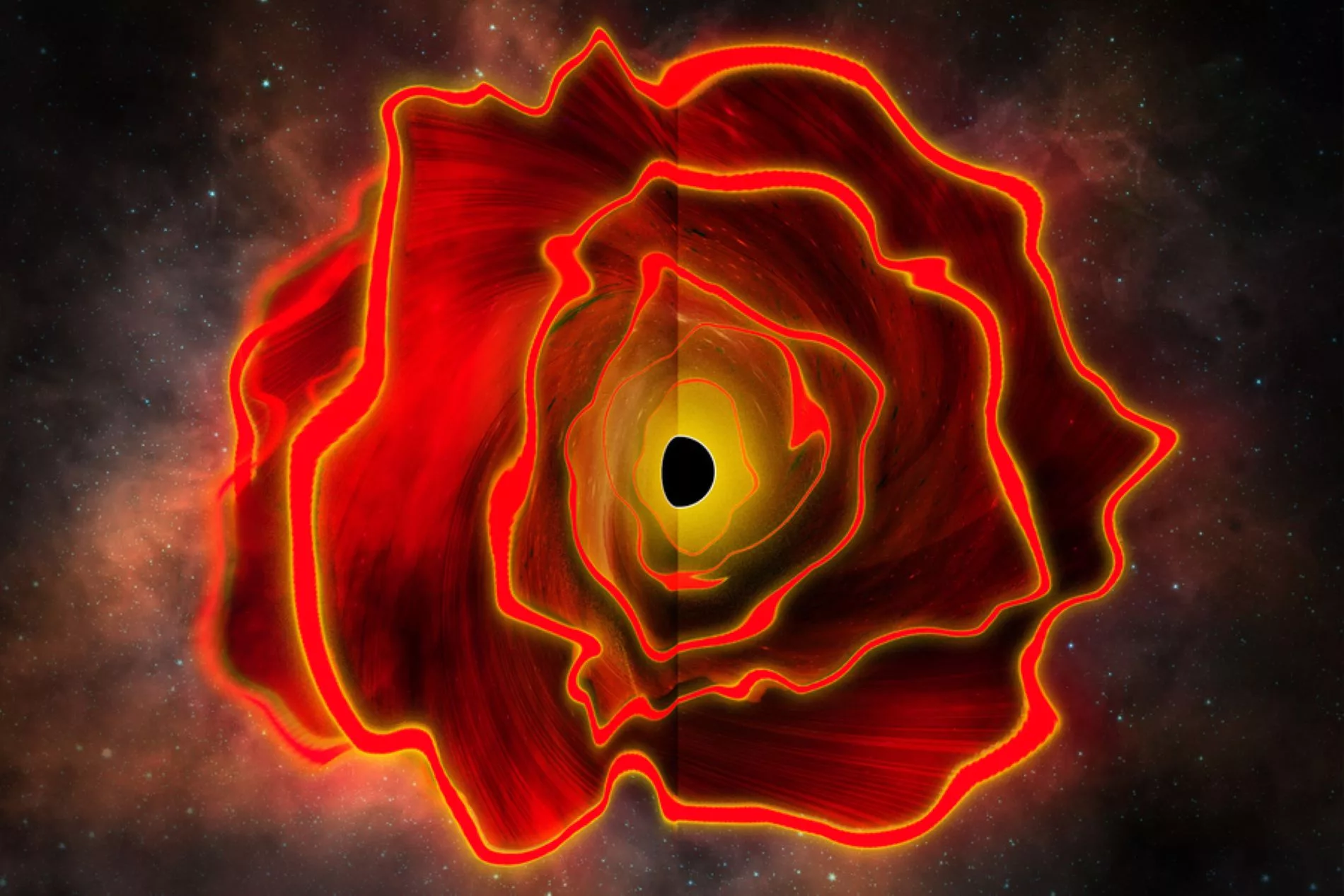
Astronomers using the James Webb Space Telescope (JWST) have discovered a cosmic oddity: an extremely bright red dot shining in the early universe with 100 billion times more energy than any star could physically produce. The object, seen just a few hundred million years after the Big Bang, appears to be a mashup of two extremes, a star and a black hole.
The object, named MoM-BH-1* after the team’s “Mirage or Miracle” survey, may be the first of many. The team, led by MIT’s Rohan Naidu, calls it a “black hole star.”
Their analysis suggests the source is a central black hole about 100,000 times the mass of the Sun, wrapped in a vast envelope of hydrogen gas roughly the size of our solar system. This cocoon makes the object look star-like, but its staggering brightness points to the black hole as the true power source.
“Our picture of this object is evolving very rapidly,” Naidu said.
“We think there is a central black hole… and around this black hole, there would be this very extended envelope of gas that looks like a star the size of the solar system. It’s huge.”
The finding could provide insight into the mysterious “little red dots” that JWST has spotted across the early cosmos. The dots appear all around the young universe but have disappeared by today. If so, these high-mass stars may have formed quickly and died young, paving the way for an important phase of cosmic evolution.
The team wasn’t actually searching for a black hole star. Their project, called Mirage or Miracle (MoM), aimed to find the earliest galaxies using the James Webb Space Telescope, peering back to when the universe was only a few hundred million years old. The puzzle they faced was that many extremely bright galaxies seemed to appear at these early times, some “miracles” that might instead be “mirages.”
In reviewing JWST’s images, the team noticed a very bright red dot that was unusual. Normally, astronomers would assume that this redness is due to dust, like the way wildfire smoke used to turn our skies red. However, the light patterns did not line up with what you would expect dust to do.
In fact, that dot lost its brightness entirely below some wavelengths, a bizarre signature suggesting something much more exotic than a dusty galaxy.
The team’s observations revealed a Balmer break, a sharp drop in light at certain wavelengths caused by dense hydrogen gas absorbing photons. This feature is common in stars, but here it was deeper than ever seen before, ruling out ordinary stars.
To figure out what the mysterious red dot could be, the team ran simulations of different scenarios, testing which astrophysical features might explain its unusual color.
MKI Director Robert Simcoe said, “We started to ask: Could you make something that red using just hydrogen, without any dust?”
Simulations showed that only a black hole embedded in a hydrogen cocoon could reproduce the observed signals.
MIT physicist Robert Simcoe explained the redness by comparing it to wildfire smoke turning skies red: dust can redden light, but here hydrogen alone was responsible.
“To our surprise, it turns out you can make something that red using just hydrogen,” he said.
“Every little red dot is consistent with being a black hole star,” Naidu noted. “But what is special about MoM-BH-1 is that the black hole star is essentially completely outshining its surrounding host galaxy, such that we’re seeing pure black hole star light.”
If confirmed, black hole stars could help solve one of astronomy’s biggest puzzles: how supermassive black holes grew so quickly in the universe’s infancy. For now, MoM-BH*-1 stands as a cosmic first, an object that looks like a star, behaves like a black hole, and may be a missing link in the story of how galaxies and black holes came to be.
Journal Reference:
- Naidu, R.P., Matthee, J., Katz, H. et al. A gas-enshrouded and gas-reddened black hole at cosmic dawn. Nature 656, 329–333 (2026).DOI: 10.1038/s41586-026-10846-4


