

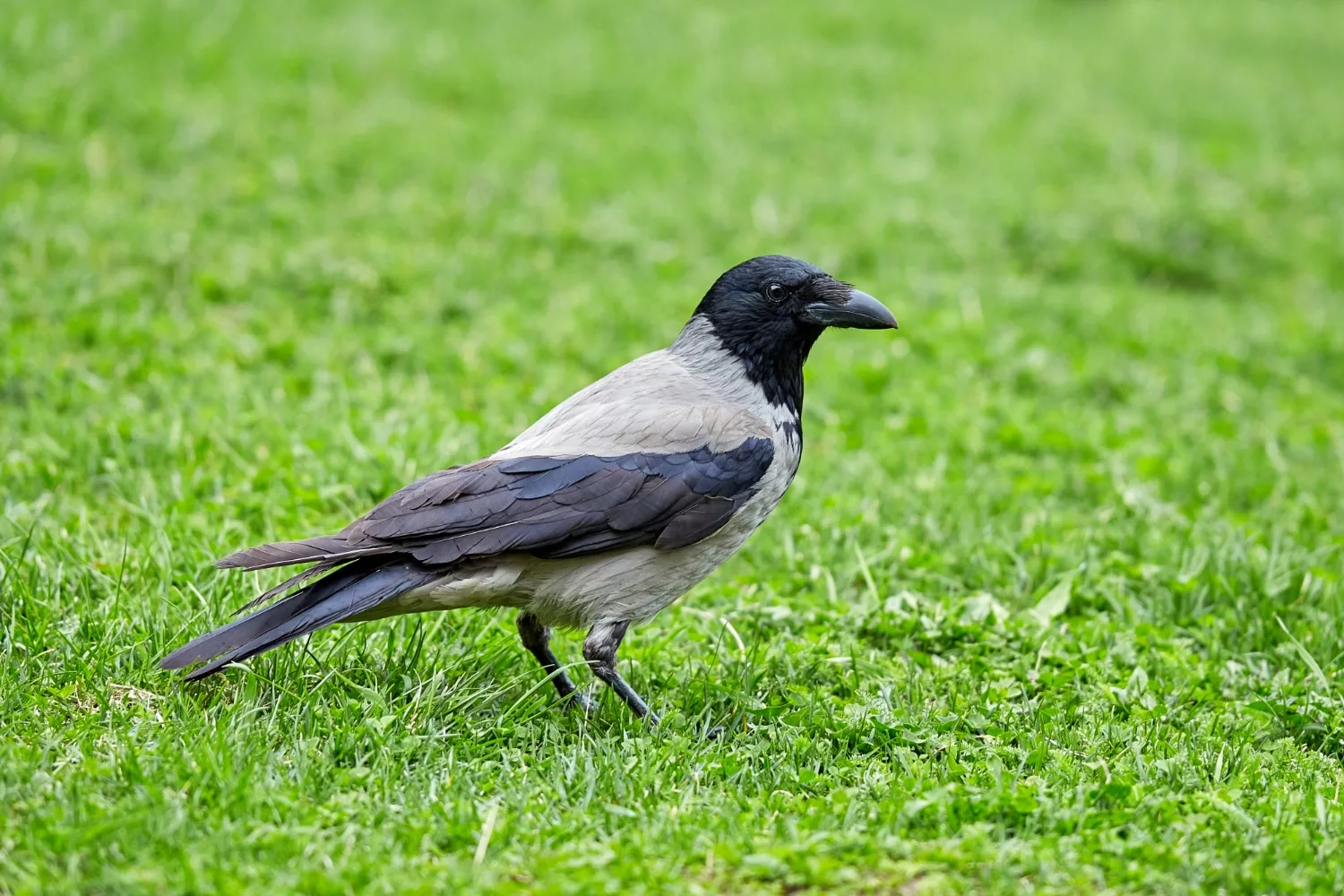
The 150-million-year-old fossil known as Archaeopteryx, which is often regarded as the first bird, might not have taken off into the air with one strong jump. While many modern birds do take off in that manner, Archaeopteryx probably didn’t. A recent biomechanical study suggests that it would have needed two or three hops to reach the speed necessary for flight. It’s similar to a crow hopping over a lawn rather than a sparrow leaping off a branch.
The study was carried out by a group at the University of Southampton and was directed by Erik A. Meilak together with Neil J. Gostling, Colin Palmer and Markus O. Heller; Pauline Provini from the Muséum National d’Histoire Naturelle in Paris also took part. The researchers’ work is published in the journal Developmental Biology and deals with one of paleontology’s most longstanding puzzles, namely, how the earliest birds actually managed to get off the ground.
A crowded field of competing ideas
Over the years, scientists have put forward a number of different theories about how powered flight might have evolved. One of these suggests that ancestors who lived in trees leaped from branch to branch and then gradually improved those leaps until they became true flight. In another theory, birds flap their wings mainly to help their legs get a better grip and climb steep or vertical surfaces, with flight-like wing movements developing as a result of this assistance. A third theory, on which the new study is based, holds that flight originated when an animal accelerated over the ground before finally leaving it. Each of these hypotheses is supported by evidence from various fossil groups and from existing species. The present study does not aim at settling the argument between them. Rather, it poses a more specific and testable question: considering what is known about the anatomy of Archaeopteryx, could a ground-up, multi-hop method have been physically feasible?
A body built for hopping, not for a single big jump
Birds that take off quickly today, for example, zebra finches, achieve this by means of a sudden extension of the leg together with a strong downstroke of the wings; this combination causes them to shoot upwards immediately. However, the anatomy of Archaeopteryx does not match this scenario. Present-day birds have a keeled sternum, that is, a blade-shaped ridge of bone down the center of the chest, to which the large flight muscles attach in the same way that a climbing rope attaches to a carabiner, enabling the muscles to pull with sufficient force to bring the wings down with real power. Archaeopteryx did not have such a keel, and moreover, its shoulder joint was less flexible than that of modern birds, unable to rotate and lift the wing through the same wide arc. These two characteristics indicate that it could not produce the quick, high-amplitude wing beats required by a single-leap takeoff.
Archaeopteryx had strong legs; its hindlimbs accounted for about 13 percent of its total body weight, which is considerably more than the 9 to 10 percent found in modern birds. This is a significant amount of leg muscle and suggests another possibility: that instead of leaping once and then flying, Archaeopteryx might have increased its speed gradually, as many ground-dwelling birds do today.
You can see this behavior yourself. Crows and magpies are a typical example. If you observe one on a lawn or in a park and it isn’t in a hurry, you’ll notice that it makes a number of short, low hops with its wings mostly tucked in before finally spreading its wings and taking off. That ordinary sight, since it appears so unimpressive that it’s easy to overlook, is in effect the same strategy that this study suggests was used by Archaeopteryx, merely carried out by a completely different animal 150 million years later.

Figure adapted from Meilak et al., 2026, Developmental Biology, licensed under CC BY 4.0.
Building a virtual Archaeopteryx
To find out whether this leaping strategy might actually work, the researchers constructed a detailed computer model of the hind leg of Archaeopteryx. The model was based on a musculoskeletal model originally developed for the study of reptiles in the bird line. It was scaled to a body mass of 400 grams, a value obtained from measurements of a well-preserved fossil specimen. They also adjusted the leg proportions to correspond with the renowned London specimen of Archaeopteryx.
It’s impossible to place a 150-million-year-old fossil on a treadmill, so the group had to use a living creature as a stand-in. For this purpose, they used detailed motion-capture and force-plate data recorded from real zebra finches during takeoff, then adapted that mode of movement to match Archaeopteryx’s different leg proportions and joint range of motion. They also verified their findings by referring to take-off data from carrion crows, a bird whose size is much closer to that of Archaeopteryx. The team then calculated the forces and torques acting at the hip, knee, and ankle during a leap and compared them with the forces that Archaeopteryx’s leg muscles could plausibly generate. On that basis, they were able to estimate how fast it could have launched itself using only its legs, without assistance from flapping.
Two to three hops were enough
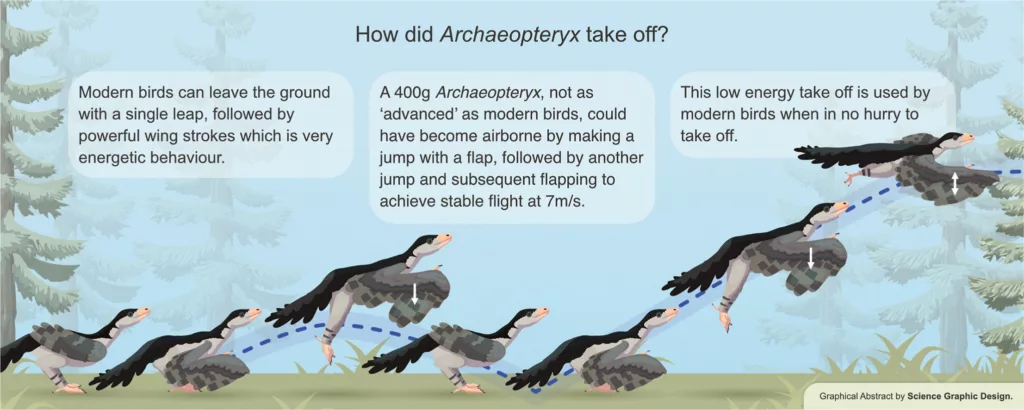
If Archaeopteryx had made a single jump using only its hind limbs, it would have reached a speed of about 3 meters per second, which is still short of the approximately 7 meters per second required for sustained flight. This is why the idea of a series of jumps is important. Suppose that Archaeopteryx took a number of hops, carrying on the momentum from one jump into the next. In that case, the figures change considerably. Three consecutive jumps with no assistance from its wings could have built up a speed of around 6.7 meters per second, just a small amount more than needed to achieve flight speed. If two jumps were combined with a downstroke of the wings in between, it would reach that speed even more quickly. This method attained sustainable flight speed in less than half a second after becoming airborne.
In the model, the ankle was always the limiting joint; the ankle muscles’ ability to generate sufficient extension force finally determined how quickly Archaeopteryx could accelerate during any one leap, and this same pattern is seen in living birds today.
What it means for the story of how birds took flight
The researchers present this as one possible mechanism rather than a final solution and are clear about the uncertainties involved. Since there is no living Archaeopteryx available for direct measurement, several of the model’s inputs are based on estimates rather than actual data, specifically, its exact body weight, the precise strength of its leg muscles, and the amount its joints could actually move. In order to deal with this, the team examined a range of reasonable values for the most difficult of these factors, namely the position of the animal’s center of mass and the exact point on its foot at which weight is borne during push-off, and found that the main conclusion, that a multi-hop takeoff was mechanically possible, remained valid throughout the entire range. The model also used data from zebra finches and crows as stand-ins for how Archaeopteryx moved, since no fossil has been filmed taking off; the comparison with crows in particular was included so the results wouldn’t simply be an effect of using a bird much smaller than Archaeopteryx.
Why is the number of hops significant? It’s not just a trivial point; it addresses a more fundamental question. Whether powered flight appeared as one sudden advance in evolution, in a literal and figurative sense, or whether it developed gradually from behaviors that these animals were already employing when moving on the ground.
This study supports the view of a gradual development. If Archaeopteryx actually used a ground-based hopping method rather than the one powerful jump typical of most modern birds, then it would indicate that flight was not a sudden innovation.
Instead, it might have developed from a more common and everyday behavior, the legs doing the main work while the wings only came into play when the animal was already moving fast enough to make use of them. This means that the origin of flight should be seen as an extension of ordinary movement rather than as a completely new ability appearing out of nowhere.
It would be worthwhile to clarify a few questions more precisely, particularly if someone is looking into the methodology.
How accurate is such a model when it’s based on modern birds and an incomplete fossil? The straightforward answer is that none of the figures given are exact, but the researchers have included a number of checks to address this uncertainty. The muscle strength of Archaeopteryx couldn’t be determined directly from the fossil since no soft tissue is preserved in the fossil record. Instead, the 32 muscle-tendon units in the model were scaled using force data from living relatives: 28 muscles from the magpie, 2 from the guineafowl, and 2 from the Nile crocodile, since crocodilians are the closest living relatives of birds outside the bird family. Body mass is also an estimate. Published estimates of Archaeopteryx’s body mass vary between 200 and 600 grams; the team adopted 400 grams based on bone-length measurements from a well-preserved specimen. Rather than regard these figures as fixed, the researchers re-ran their model over a range of possible body masses and foot pressure points and found that the main conclusion, that two to three hops would be sufficient to reach flight speed, remained valid. This kind of sensitivity test is standard procedure for transforming an inherently uncertain fossil reconstruction into a testable, quantitative statement rather than merely a guess.
Discovery of the oldest Jurassic fossils sheds light on bird origin
What can be said about the musculature of Archaeopteryx when compared with that of other early birds or feathered dinosaurs? The present study does not carry out such a comparison. Instead, its focus is more limited: it deals specifically with Archaeopteryx, using living birds, such as the zebra finch, crow, and magpie, as a source of data to estimate muscle behavior, rather than treating them as points for evolutionary comparison. Other early bird-line fossils, such as Confuciusornis or the enantiornithines, have quite different skeletal proportions and are therefore not included in this analysis. It would be a logical follow-up to make a direct comparison throughout that early bird family tree, but that is not something this paper attempts.
Can the multi-hop strategy be extended to other early birds beyond Archaeopteryx? The researchers are cautious in this regard as well. The conclusions reached apply only to Archaeopteryx because its specific leg proportions, body mass, and joint mobility have all been considered separately. Although they do suggest in their discussion that this type of ground-up leaping method could have been a more general stage in the evolution of powered flight and that another early bird lineage with a hindlimb-dominant condition might also have undergone it, that is given as a hypothesis to be tested in the future and is not presented as a conclusion proven by this study for any species other than Archaeopteryx itself.
Discovering the traits of extinct birds
Does fossil evidence in the form of trackways, for example, preserved footprints, support the idea of hopping in Archaeopteryx? The answer is no. It is best to be clear on this point: this study is completely computational. It has been based on biomechanical modeling and comparisons with living birds, not on physical trace fossils such as footprints or trackways. In fact, no trackway of Archaeopteryx has ever been recorded in the paleontological record. The advantage of such a study is that it examines whether a behavior proposed for the animal is mechanically feasible given its known anatomy. However, it cannot, on its own, prove that the behavior actually took place; for that, a completely different kind of evidence would be needed, such as trackway fossils, which have not yet been found for this species.
Journal Reference
- Erik A. Meilak, Neil J. Gostling, Colin Palmer, Pauline Provini and Markus O. Heller. Hop, hop and away: On the take-off of Archaeopteryx using a multiple leaping mechanism, Developmental Biology, volume 539, 2026, pages 57 to 64. DOI: 10.1016/j.ydbio.2026.07.018