

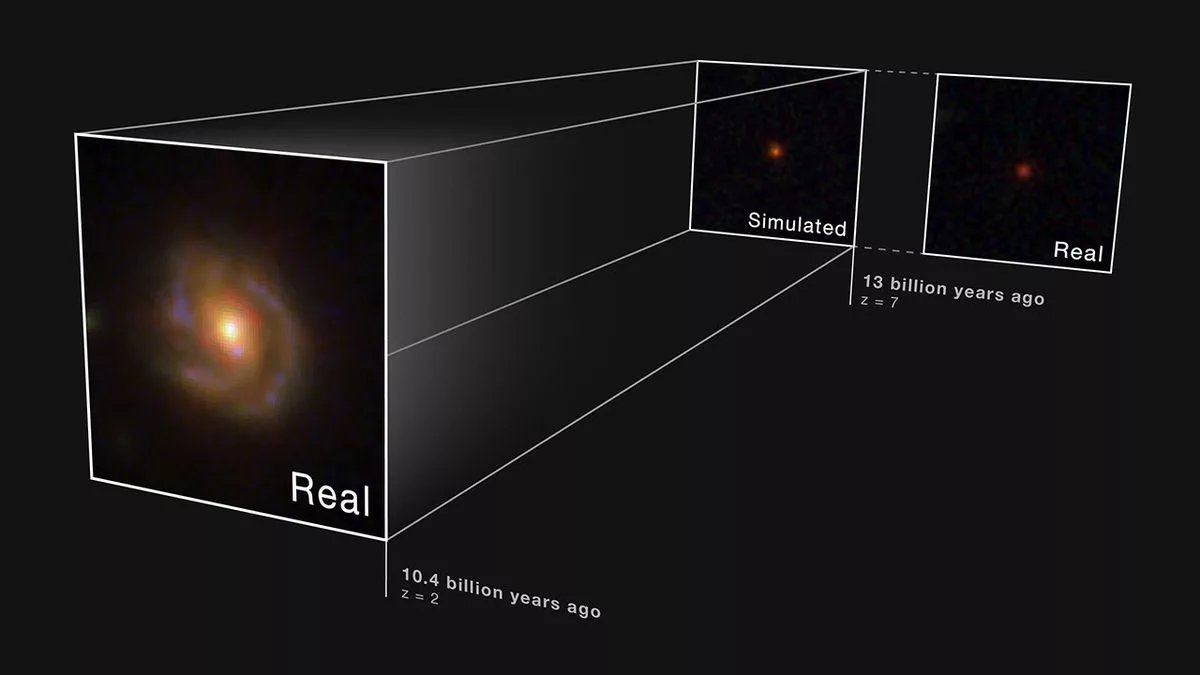
Astronomers have been puzzling over the mysterious “little red dots” (LRDs) that the James Webb Space Telescope (JWST) has revealed in the distant universe. These compact, ruby-colored sources appear abundant billions of years ago but fade away in later cosmic times. What exactly are they, and what do they become?
Now, a fresh analysis proposes that the dots may not even be an entirely separate class of object: instead, we are seeing bright, compact nuclei deep in those galaxies whose dimmer extended structures have been lost behind time and distance.
The team, co-led by Pierluigi Rinaldi with the University of Arizona and now at the Space Telescope Science Institute, focused on a striking example: a spiral galaxy at redshift 2, nicknamed the “Saguaro.”
The Saguaro’s center glows like a prototypical little red dot, while its spiral arms stretch outward like the cactus it’s named for. When researchers simulated how the galaxy would look farther away, at redshift 7, the arms faded from view, leaving only the bright red nucleus. In other words, the galaxy would masquerade as a classic LRD.
“Everything created in the early universe must evolve into something around us. We have had little idea of what LRDs become, but these results finally show us how to find their progeny,” said George Rieke of the University of Arizona.
The team used archival data from both Hubble and Webb, combining ultraviolet and infrared insights to unravel Saguaro light emitted as radiation during its host galaxy’s existence and colored images cast off at a dense core. They also detected faint X-ray emission with NASA’s Chandra Observatory, evidence that the nucleus harbors an active galactic nucleus (AGN), a supermassive black hole consuming matter.
This obscured, X-ray-weak AGN could be a reason that most high-redshift LRDs do not have a detectable signature in their X-rays. “It fits the puzzle of little red dots nicely,” said co-author Carys Gilbert of the University of Cape Town.
This emission is so faint that it would not have been detected without stacking images of almost 100 different LRDs and, having done this, the researchers also found fainter nebulous emission surrounding these large galaxies, hinting at even more hidden host galaxies.
Based on their analysis, they argue that the dots appear compact because of surface-brightness dimming, a cosmological phenomenon in which light from more distant structures fades.
The conclusion: LRDs might be an ephemeral evolutionary stage of black hole-dominated galaxies, not a new class of object. The Saguaro offers a rare view into this phase at low redshift, and helps astronomers map the family tree of these intriguing sources.
As Rinaldi put it, “Little red dots are far more complex than just being a dot. They’re just the tip of the iceberg of a supermassive black hole interacting with its nearby surroundings.”
Journal Reference:
- Pierluigi Rinaldi, George H. Rieke, Zihao Wu, Carys J. E. Gilbert, Fabio Pacucci, Luigi Barchiesi, Stacey Alberts, Stefano Carniani, Andrew J. Bunker, Rachana Bhatawdekar. Beyond the Dot: An LRD-like Nucleus at the Heart of an IR-bright Galaxy and its Implications for High-redshift LRDs. The Astrophysical Journal. DOI: 10.3847/1538-4357/ae80cd