
Astronomers have long suspected that some of the universe’s most powerful particle accelerators lurk in binary star systems. Now, the Large High Altitude Air Shower Observatory (LHAASO) in China has revealed that Cygnus X-3, a peculiar binary system in the constellation Cygnus, is the highest-energy gamma-ray source ever detected.
The study, published in National Science Review, shows that Cygnus X-3 produces cosmic rays with energies reaching at least 30 petaelectronvolts (PeV), far beyond what current theories predict for sources inside our galaxy. For comparison, one PeV equals a million billion electronvolts, an energy scale that dwarfs even the most powerful human-made accelerators.
LHAASO detected flaring activity in ultra-high-energy gamma rays (above 10¹⁴ eV) that matched signals seen in the much lower-energy GeV band by NASA’s Fermi satellite. Both sets of signals pulsed with a 4.8-hour periodicity, reflecting the binary system’s orbital motion. This correlation allowed scientists to pinpoint the accelerator’s location to within a region only three times the size of the Sun, an unprecedented precision for such extreme phenomena.
“This study confirms Cygnus X-3 as the first ultra-high-energy gamma-ray source with temporal variability,” the researchers reported.
Hubble captured a very beautiful image of Cygnus supernova
That variability opens the door to a new field: time-domain astronomy at ultra-high energies, where scientists can track how cosmic accelerators change over hours or days.
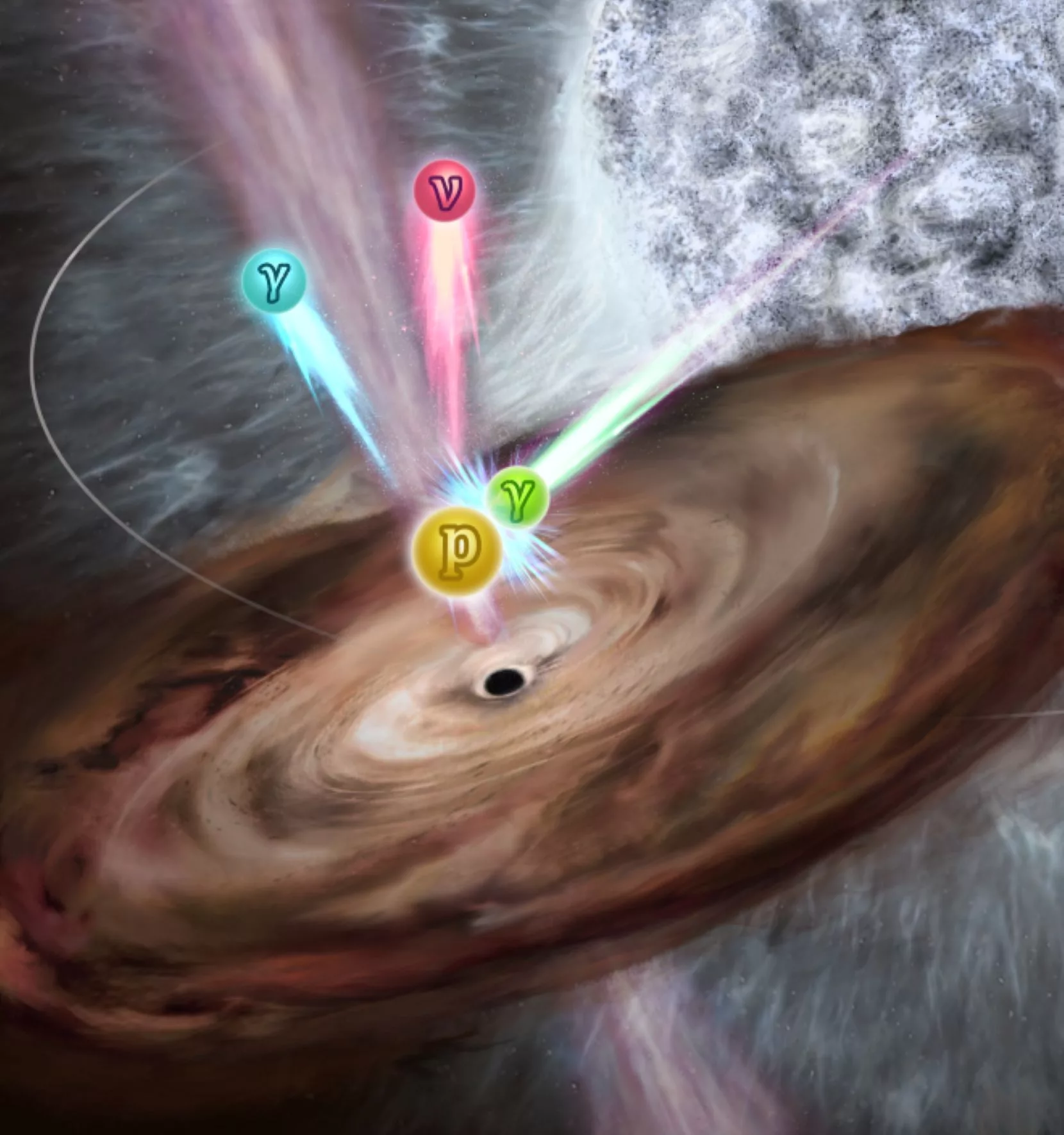
Cygnus X-3 is thought to contain a compact object, likely a black hole or neutron star, locked in orbit with a massive companion star. The system’s intense environment appears capable of hurling particles to energies that challenge existing models of Galactic accelerators.
The discovery has profound implications for multi-messenger astronomy, which combines signals from light, particles, and gravitational waves to study the universe. By confirming Cygnus X-3 as a source of ultra-high-energy cosmic rays, researchers gain a new laboratory for probing the physics near compact objects and for understanding how the galaxy’s most extreme accelerators operate.
Journal Reference:
- Zhen Cao, Felix Aharonian, Yun-Xiang Bai et al. Cygnus X-3: A variable petaelectronvolt γ-ray source. National Science Review. DOI: 10.1093/nsr/nwag435