
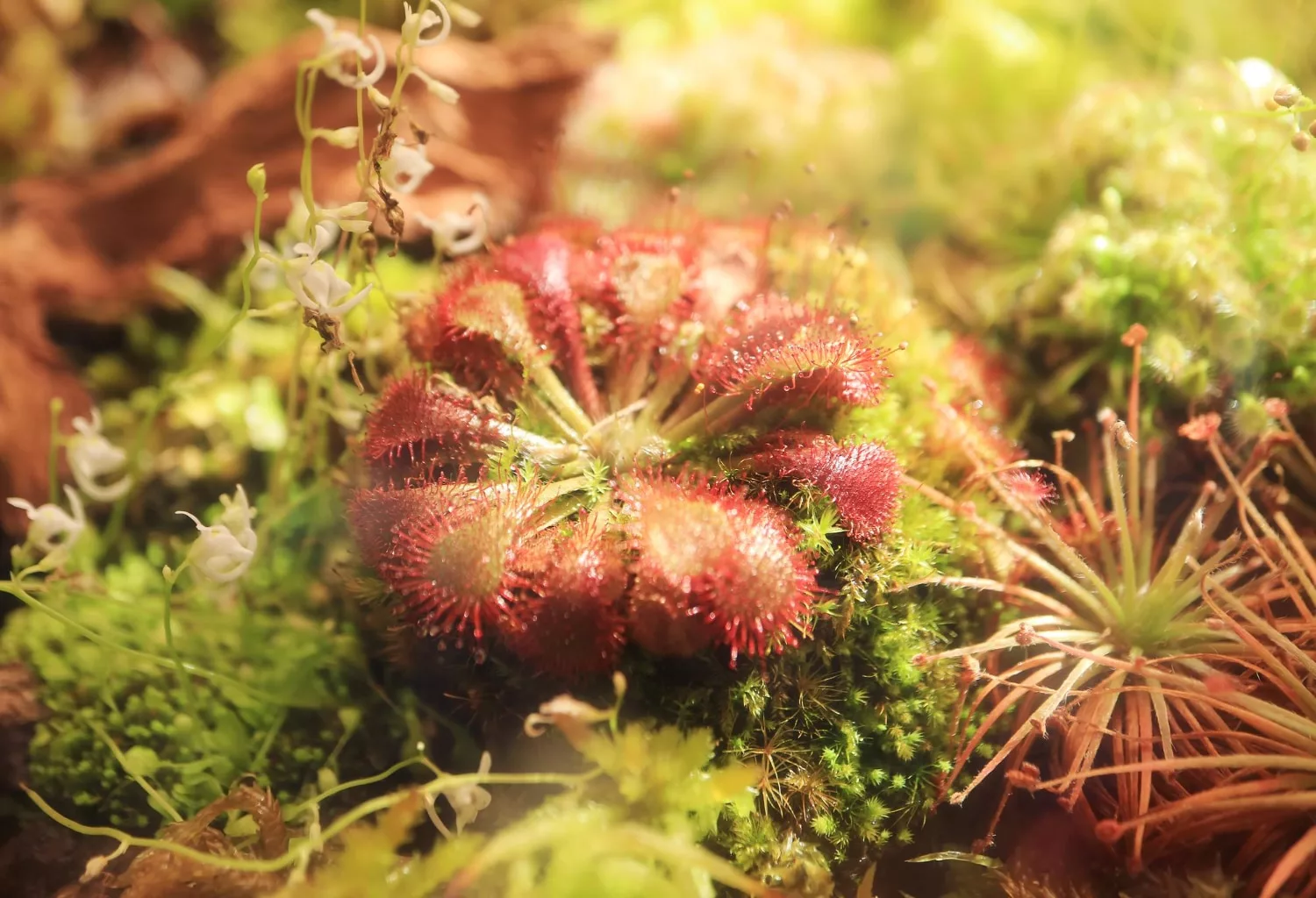
A carnivorous plant may keep track of past attacks on its leaves. It then uses that memory to protect its flowers, a new study suggests. Researchers found that when the sundew Drosera spatulata had already lost leaf tissue to a simulated caterpillar attack, its flowers snapped shut far more tightly when touched. This happened even though the flowers themselves had never been harmed.
Drosera spatulata is a small, sticky-leaved sundew. It grows across Japan, New Zealand, Australia, Southeast Asia, and China. Its pink flowers open for just a few hours each morning. Like the plant’s famous prey-trapping leaves, they can move, too. Touch the base of an open flower, and within 5 to 15 minutes it closes. Once shut, it stays that way for good.
This isn’t about catching insects for food. It’s a defense. The flower closure protects the plant’s ovules from Buckleria paludum, a caterpillar that has evolved to feed on sundews without getting stuck in their mucilage. These caterpillars start out chewing on leaves. Days later, they climb up to the flowers to feed on the more valuable reproductive tissue inside.
That timing gap gave a team of Japanese biologists an idea worth testing. Kazuki Tagawa of Naruto University of Education led the work, along with Haruka Osaki of the Museum of Nature and Human Activities, Hyogo, and Mikio Watanabe of Aichi University of Education. They wondered whether damage to a plant’s leaves could serve as an early-warning sign. If so, the plant might use that signal to prepare its flowers for a coming attack.
Testing whether leaves talk to flowers
To find out, the researchers collected flowering Drosera spatulata plants from a wild population in Tokushima, Japan. The caterpillar hadn’t been spotted at this site in over two years, ruling out any real prior herbivory. In the lab, the team split the plants into two groups. One group had roughly half of two leaves snipped off with scissors the evening before their flowers opened, mimicking a caterpillar’s feeding. The other group was left alone as a control.
Caterpillar venom could be key to the delivery of lifesaving drugs
The next morning, every plant received the same treatment, whether damaged or not. A researcher gently poked the base of each open flower with forceps 10 times. This simulated the kind of ambiguous contact a caterpillar, a raindrop, or a gust of wind might all produce. Photographs were taken before the poking, and again at 5 and 15 minutes afterward. Image-analysis software then measured exactly how far each flower had closed by calculating the angle between the outer petals and the base of the flower.
Flowers with a memory of leaf damage closed faster and tighter
The results pointed to something more sophisticated than a simple reflex. Fifteen minutes after being touched, flowers on plants with prior leaf damage had closed to significantly smaller angles than those on undamaged control plants. That meant their defensive response was stronger. Timing mattered too. Control plants closed more sluggishly early in the day and more tightly as the morning wore on. This likely reflects the falling value of staying open for pollination as flowering time runs out. Plants with damaged leaves behaved differently. They closed tightly and consistently, no matter what time they were touched, as if they had already decided the threat was real.
The leaves and flowers are entirely separate organs, so the effect can’t be explained by direct injury to the flower itself. Instead, the plant appears to be integrating information from one part of its body. It then uses that information to fine-tune a defensive decision made in another part. The researchers describe this as cross-organ priming.
This fits into a broader idea in plant biology called error management. A touch on a flower could come from a harmless breeze or from an actual caterpillar. Plants that respond to every touch waste energy and miss out on pollination. Plants that ignore every touch risk losing their reproductive tissue. Prior leaf damage seems to shift the odds in the plant’s internal calculation. It makes the plant more likely to treat an ambiguous touch as a genuine threat.
The underlying mechanism is still unclear, the researchers note. They point to jasmonic acid as a likely candidate for carrying the message from leaf to flower. This hormone is already known to carry wound signals through sundew tissue. The team also suggests that this kind of priming could carry a reproductive cost. Closed Drosera flowers self-pollinate, so a plant that closes early or too tightly may end up relying more on selfing. That shift comes with its own trade-offs for genetic diversity.
Plants treated with herbicides incur more damage from insects
The findings add to growing evidence that plants are capable of a kind of memory, the team writes. This holds true even though plants lack a nervous system. They can retain information about past damage and draw on it later to shape decisions elsewhere in the body.
Journal Reference
- Kazuki Tagawa, Haruka Osaki, and Mikio Watanabe. Leaves Alert Flowers: Prior Leaf Herbivory Enhances Contact-Induced Defensive Floral Closure in Drosera spatulata (Droseraceae), Ethology, 2026. DOI: 10.1111/eth.70093